Bridging the Gap: Ukraine’s Strategic Strike on the Kerch Strait During the Shenzhen Summit
In a sophisticated multi-stage operation, Ukrainian forces severely damaged the Kerch Bridge on November 19, 2026, timing the attack to coincide with the high-profile meeting between Trump, Xi, and Putin in Shenzhen.

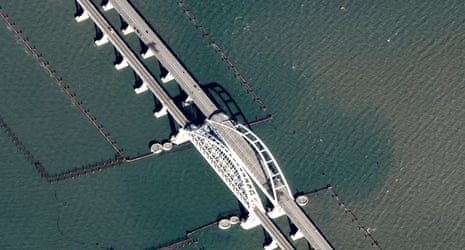
In the early hours of November 19, 2026, the Kerch Bridge—the critical 12-mile link between Russia and the occupied Crimean Peninsula—was struck for the third time in a single week 12. This latest attack, which targeted the remaining railway section of the structure, followed a devastating strike on November 17 that had already collapsed a 227-meter section of the road bridge into the sea 12.
The Ukrainian General Staff indirectly confirmed the success of the operation on social media by "congratulating" the Vasco da Gama bridge in Lisbon for regaining its title as the longest bridge in Europe 34. Russian-installed governor Sergei Aksyonov confirmed the attack, which led to a temporary halt of all rail traffic, though he claimed "heroic efforts" by repair workers allowed some services to resume by 4:00 PM that afternoon 23.
A Seven-Stage Masterclass in
Sabotage. President Volodymyr Zelensky described the campaign against the bridge as an "unprecedented operation" that was weeks in the making 1. According to Ukrainian military sources and OSINT analysts, the operation consisted of seven distinct stages, beginning with the systematic destruction of Russian air defense systems, radars, and electronic warfare assets protecting the Kerch Strait 15.
On November 16, hundreds of drones were launched to exhaust Russian interceptor missiles and strike oil refineries 65. The final stages involved a coordinated use of 11 different types of weaponry, including domestically produced "Palianytsia" drones, "Neptune" cruise missiles, and "Flamingo" precision-guided missiles 78.
Zelensky noted that the "Palianytsia" drones were particularly effective in striking the road section, while a combination of "Ruta" and "FP-5" drones targeted the railway line 7.
The 'Flying Modem' Breakthrough. A significant technical aspect
of the operation was the successful avoidance of Western-controlled satellite networks 6. Reports from The Times, citing Ukrainian military sources, indicate that the strikes were carried out without the use of Starlink or its military version, Starshield 6. Instead, Ukraine utilized a proprietary network of "flying modems" and repeaters that provided a stable communication uplink over distances of 400 to 600 kilometers 6.
This allowed drones to relay video signals directly to missiles, ensuring high precision even in the face of alleged attempts by U.S. entities to "paralyze" Ukrainian communications to prevent such escalations 6. This technological independence is seen as a major milestone for the Ukrainian defense industry, which now produces over 50% of its own weaponry 6.
Diplomatic Embarrassment and
Symbolic Timing. The timing of the strike was widely viewed as a deliberate attempt to undermine Vladimir Putin’s prestige during the APEC summit in Shenzhen 27. By striking the bridge just hours before Putin’s historic meeting with Donald Trump and Xi Jinping, Kyiv sent a message that the Russian leader is "not as strong as he pretends" 2.
While Putin claimed at a press conference in Shenzhen that the bridge was a purely civilian structure, Kyiv countered that the bridge is a "hated symbol of Russian arrogance" and a vital logistical artery for resupplying troops in southern Ukraine 12. The strike forced Putin to address the issue on the world stage, where he vowed a "far more painful" response to the attacks 1.
Logistics and Local Panic. The repeated strikes have
caused significant logistical disruptions and sparked panic among the civilian population in occupied Crimea 39. In Sevastopol and Simferopol, residents began mass-buying food and fuel, fearing that the damage to the bridge would lead to a total blockade 39. Local occupation authorities were forced to implement fuel rationing, limiting sales to 20 liters per person in canisters 10.
The collapse of the road arch also blocked the main shipping channel to the Sea of Azov, effectively turning it into a "de facto lake" and further complicating Russian maritime logistics 114. Despite Russian claims that the bridge would be rebuilt "even better than before," the Ukrainian side has asserted that the bridge will not remain standing after the war 112.
The Kerch Bridge, completed in 2018 at a cost of $3.7 billion, is a key symbol of Russia's occupation of Crimea . Ukraine has previously attacked the bridge in 2022, 2023, and 2025 . The 2026 campaign represents the most sustained and technically complex effort to date .
Russian transport officials are assessing the long-term damage to the railway section, while car traffic remains prohibited for the foreseeable future . Ukraine's Defense Minister has stated that the country plans to triple its 'deep-strike' capabilities by 2027 .
Written with AI from the cited sources and checked against them. Open the sources to verify.