NASA Unveils $1 Million Moon Base Challenge as Engineering Framework for Deep Space Expansion
NASA has launched the $1 million Moon Base Challenge, inviting high school and college students across the United States to propose vital infrastructure solutions for an outpost at the lunar South Pole, linking lunar development directly to future human Mars exploration.
Crowdsourcing the Architecture for a Permanent Lunar Base
On November 16, 2026, NASA officially announced the Moon Base Challenge, a competition offering a total prize purse of $1 million to solicit innovative technical solutions for humanity's first permanent lunar outpost 1, 2. The initiative was unveiled during the MAX POWER event held at the Kennedy Space Center Visitor Complex in Florida 1, 2. Geared toward student teams from high schools, colleges, and universities across the United States, the program aims to channel academic creativity into operational engineering concepts for long-term off-world survival 1, 2. Registration is administered via the NASA STEM Gateway, with the challenge organized through a collaboration between NASA's Office of STEM Engagement and the agency's Moon Base Program 1, 2.
NASA leadership framed the challenge not merely as an educational exercise, but as an active pipeline for unconventional technical insight 1, 2. "We're looking for students ready to think creatively, work as a team, and take on real problems connected to NASA's future on the Moon," stated NASA Administrator Jared Isaacman 1, 2. Isaacman stressed that participants need not wait until graduation to make meaningful contributions, emphasizing that curiosity, creativity, and the appetite to tackle ambiguous engineering problems are vital to building humanity's permanent space infrastructure 1, 2. Operationally, the competition is managed by the Institute of Competition Sciences under a contract with NASA's Center of Excellence for Collaborative Innovation, housed within the Research and Technology Mission Directorate 1.
Carlos García-Galán, manager of the Moon Base Program, underscored that the agency seeks to leverage fresh perspectives to address the exhaustive operational matrix of operating on the Moon 1. "As we build and design the foundations of Moon Base, we want to leverage all the ingenuity and innovation to think of every consideration our explorers might need to live and work there," García-Galán explained 1. Elaine Ho, associate administrator for the Office of STEM Engagement at NASA Headquarters, likewise noted that students represent the incoming cohort of aerospace innovators whose viewpoints are necessary to conceptualize sustained human activity beyond Earth 1.
Six Critical Engineering Pillars for Surviving the South Pole
The Moon Base Challenge requires student teams to focus their design proposals on six primary technological areas: power generation and storage, facility construction, life support systems, surface transportation, communications networks, and astronaut protection 1, 2. These areas directly reflect the harsh operating environment that NASA anticipates encountering at its designated target area near the lunar South Pole 1. Sustaining continuous human presence in this region requires enduring extreme temperature swings, navigating rugged terrain, and managing prolonged periods of shadow or low-angle sunlight 1.
The structure of the competition demands rigorous technical output mirroring actual aerospace industry practices 1, 2. Rather than conceptual sketches alone, competing student groups must conduct comparative evaluations of competing technical designs, compile formal engineering proposals, and deliver presentations directly to project stakeholders 1, 2. The agency noted that this multi-phase evaluation will force teams to balance mission trade-offs, such as mass limitations, power efficiency, and physical durability, under realistic lunar conditions 1.
NASA views permanent lunar habitation as an essential operational precursor to long-distance planetary expeditions 1. By solving closed-loop life support, regolith manipulation, and power reliability near the lunar South Pole, the agency intends to prove technologies required for future crewed voyages to Mars 1. García-Galán pointed out that the generation participating in the challenge represents the people who will actually inhabit a future where humanity remains permanently off Earth 1.
Historical Lunar Precedents and the Mars Science Continuum
The modern push to construct stationary facilities on the Moon follows decades of incremental robotic scouting that began in the 1960s 3. Exactly 59 years before the Voyager 1 distance milestone, on November 17, 1967, NASA's Surveyor 6 spacecraft performed the first-ever powered liftoff from the lunar surface after making a soft touchdown in Sinus Medii on November 10, 1967 3. During that engineering test, Surveyor 6 fired its engines for 2.5 seconds, lifting 12 feet into the air and hopping 8 feet away 3. The test confirmed that rocket engines could safely restart on another celestial body, validating the ascent mechanism necessary for Apollo 11 astronauts less than two years later 3. Scientists at the Lunar and Planetary Institute noted that Surveyor 6's hop also allowed immediate photographic evaluation of surface disturbances and rocket exhaust imprints, providing foundational data on lunar soil mechanics 3.
While the Moon serves as the operational baseline, NASA's parallel planetary missions illustrate how surface resource identification informs habitat planning 4, 5. On November 18, 2013, NASA launched its MAVEN spacecraft to Mars to determine how solar wind stripped the Red Planet of its atmosphere and surface water 5. MAVEN operated for more than 11 years, collecting atmospheric composition and solar interaction data that NASA planetary science director Louise Prockter stated is critical for designing radiation protection systems for future Mars crews 5. Following an uncontrollable spin and power loss in December 2025, MAVEN's mission officially concluded in June 2026, leaving a substantial baseline of environmental radiation data 5.
More recently, NASA initiated the SkyFall mission in March 2026, an effort to deploy three Ingenuity-class mini-helicopters across Mars 4. SkyFall Project Scientist Matthew Golombek highlighted that the helicopters will carry ultra-small ground-penetrating radar equipped with flexible antennas to locate subsurface ice deposits in regions such as Arcadia Planitia 4. Such subsurface ice is considered vital for prospective human missions, serving both as life-support consumables and as in-situ feedstock for rocket propellant 4. However, former NASA Mars Program Director Scott Hubbard labeled the pairing of SkyFall with the nuclear Space Reactor-1 Freedom carrier rocket a programmatic "shotgun marriage," showing how deep-space technical requirements frequently trigger logistical and strategic debates within the scientific community 4.
Distant Horizons: From the Lunar Surface to Voyager's Frontier
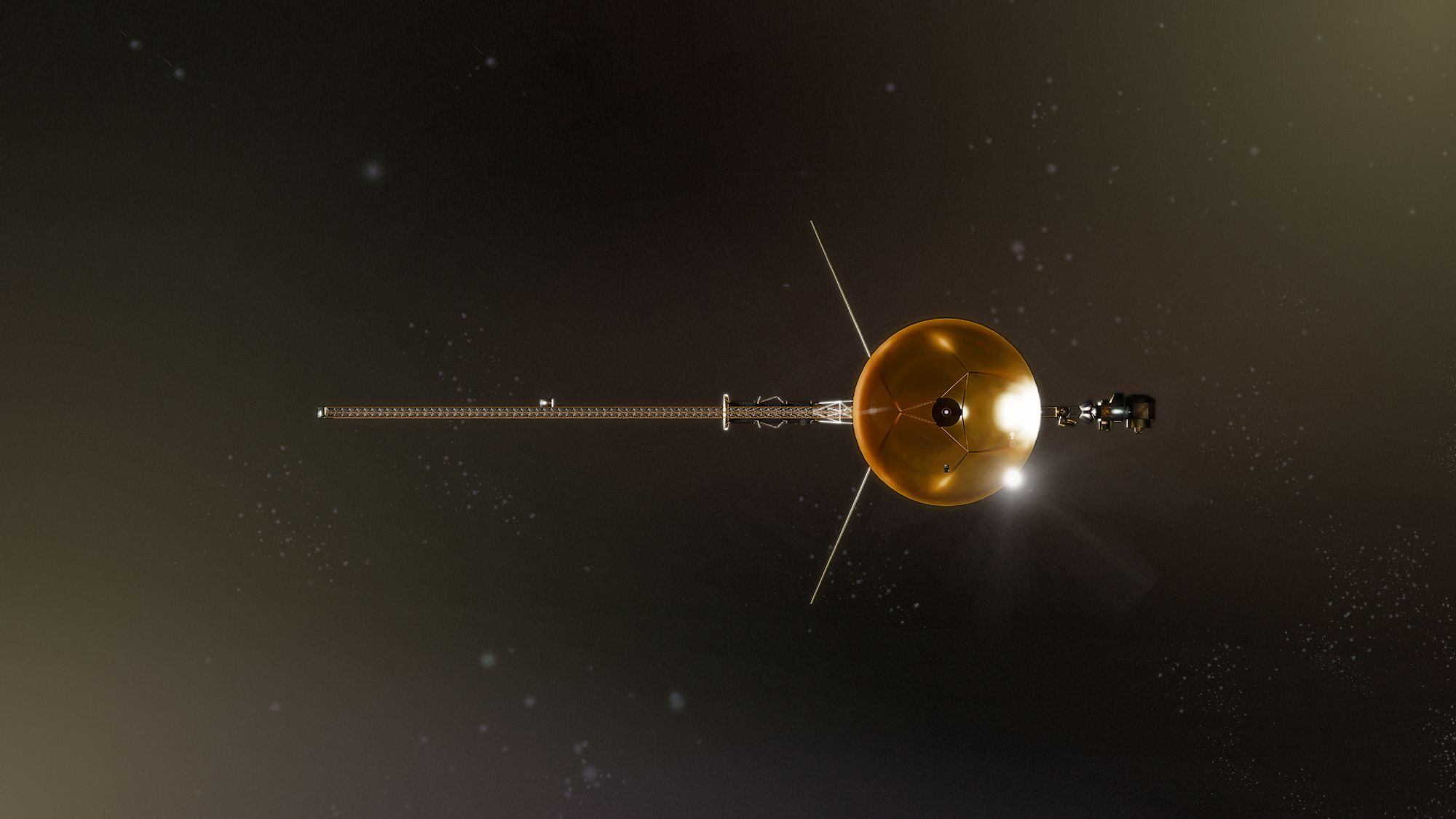
NASA's forward-looking human architecture emerges alongside historic longevity milestones achieved by its legacy robotic missions 6, 7. On November 18, 2026, at 5:16:07 a.m. EST (101607 GMT), the Voyager 1 interstellar spacecraft officially reached a distance of one light-day from Earth—approximately 16.1 billion miles (26 billion kilometers)—making it the first human-made object to do so 6, 7. At this distance, radio signals traveling at the speed of light require a full 24 hours to reach the probe, requiring 48 hours for round-trip mission communications via the Deep Space Network 6, 7.
To mark Voyager 1's crossing, NASA invited global participants on November 17 to project Morse code flashes representing the probe's call sign, "VGR," into the night sky through an automated web tool 8. Voyager Project Scientist Linda Spilker noted that the spacecraft, launched on September 5, 1977, continues gathering interstellar medium and cosmic ray data through careful power-budget swaps managed by a small flight team at the Jet Propulsion Laboratory 6, 7. Meanwhile, its twin Voyager 2 is not projected to reach the one light-day mark until 2035 due to a different trajectory and speed 6, 9.
For the Moon Base Challenge, NASA's focus remains fixed on near-term technical viability 1, 2. What remains unknown is how student proposals will be integrated into the Artemis architecture and whether the designs can withstand the abrasive regolith and radiation loads documented by predecessor missions 3, 5, 1. Observers and academic institutions will be watching the upcoming evaluation cycles on the NASA STEM Gateway as participating teams transition theoretical concepts into testable engineering solutions for lunar survival 1, 2.
Written with AI from the cited sources and checked against them. Open the sources to verify.