Google Gemini allows viewing and editing of personal AI memory
Google has introduced a new feature that allows users to manage data stored in the memory of the Gemini chatbot for personalized responses.
- Users can view and edit Gemini's memory via Personal Intelligence settings.
- For Gemini's memory to work, the Keep Activity setting must be enabled.
- Google has introduced the Gemini 4 Neon model for rapid data analysis.
How Gemini Memory Works
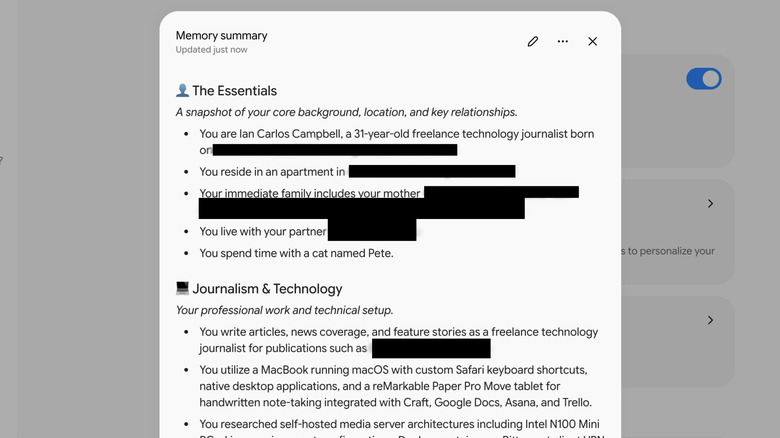
Google has updated the Personal Intelligence feature in Gemini, allowing users to see and edit information that the AI accumulates about them during conversations 1. This memory helps the bot better adapt its responses by taking into account the user's preferences and personal data, such as career or interests 1. For this feature to work, the "Keep Activity" setting must be enabled 1.
The implementation of Gemini's memory system is currently restricted to users in the United States who subscribe to a paid Google AI plan 1. To manage these settings, users navigate to the gear icon in the Gemini web app, select Personal Intelligence, and access the Memory summary 1. While the system tracks a history of all manual edits made to the profile, users can also issue direct prompts to the AI to add or subtract specific details 1.
Furthermore, the recent introduction of the Gemini 4 Neon model enhances the AI's ability to extract data from receipts or tables and integrate that information more effectively with a user's Gmail or Google Docs 2.
Data Control
Users can review the Gemini memory report through the settings menu, where information is grouped by categories 1. The editing feature allows users to delete or modify individual facts, similar to editing a document 1. Additionally, users can completely disable the memory system or delete chat history, which limits the AI's ability to use this data for personalization 1. At the same time, Google introduced the Gemini 4 Neon model, which provides faster document analysis and better integration with Google services such as Gmail 2.
Artificial intelligence is becoming increasingly personalized, which requires new tools to protect user privacy.
Further expansion of privacy control features in the Google AI ecosystem.
- Google DeepMind Updates Project Genie with Genie 4 and Chainable Worlds
Google DeepMind has released Genie 4, a new interactive 3D world model featuring real-time text editing, native audio, and community remixing tools.
- Google Gemini allows viewing and editing of personal AI memory
Google has introduced a new feature that allows users to manage data stored in the memory of the Gemini chatbot for personalized responses.
- Gemini 4 Neon Takes Top Coding Rank Amid Google's Rapid-Fire Model Sprint and Pricing Paradox
Google introduced Gemini 4 Neon on November 18, 2026, positioning it between Hydrogen and Carbon for complex coding, enterprise analysis, and science workflows. While the model claims #1 on the Artificial Analysis Coding Agent Index and strong cybersecurity scores, its launch exposes temporary pricing inversions, a dropped sibling model, and heavy reliance on company-reported evaluations.
Written with AI from the cited sources and checked against them. Open the sources to verify.