Cloud Services, Infrastructure Vulnerabilities, and Machine Learning
Modern cloud environments must balance the demands of advanced artificial intelligence customization with the security of foundational software runtimes. Vulnerabilities in core components like Java runtimes require layered defenses alongside infrastructure updates.
Introduction: The Expanding Scope of Cloud Services
Fine-tuning is the process of continuing to train a pretrained large language model on a company's own data so it adapts to a specific domain, task, or style rather than relying on general-purpose knowledge alone 1. Java is one of the most widely used programming platforms in the world, powering enterprise applications, web services, financial systems, and critical business infrastructure 2.
Fine-tuning has become an essential process for businesses looking to get more value from LLMs at lower costs 1. To meet these demands, cloud services increasingly automate infrastructure layers—such as enabling serverless model customization—so organizations can update model parameters without managing clusters or configuring distributed training 1. However, this advanced computational focus exists alongside the enduring administrative reality of core software maintenance.
Simultaneously, enterprise infrastructure remains vulnerable to critical flaws found deep within foundational software stacks. For example, widely used programming platforms like OpenJDK—which underpins enterprise Java distributions including Amazon Corretto—can suffer from severe memory-corruption vulnerabilities in core components like hardware-accelerated Base64 decoders 2.
These types of runtime flaws allow unauthenticated remote attackers to execute code or disclose sensitive information across a broad range of unrelated enterprise applications 2. Navigating these contrasting demands requires cloud platforms to simultaneously push the boundaries of automated artificial intelligence tooling and maintain rigorous security baselines across traditional enterprise runtimes.
Advanced Machine Learning Customization on SageMaker AI
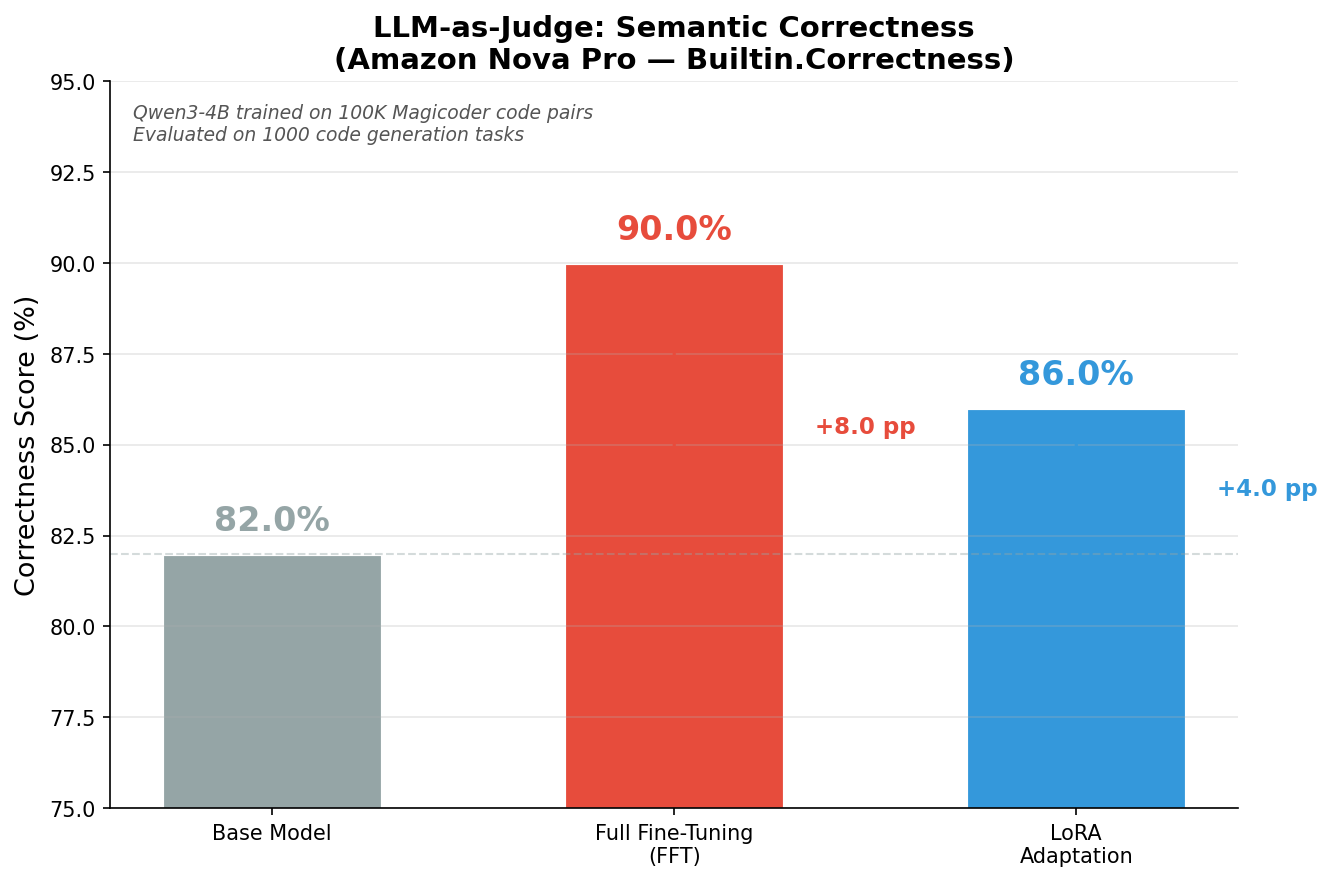
Fine-tuning is the process of continuing to train a pretrained large language model (LLM) on an organization's internal data, allowing the system to adapt to a specific domain, task, or style rather than relying entirely on general-purpose knowledge 1. This practice delivers two primary benefits for businesses: it provides measurably higher accuracy on specialized work, and it controls costs 1. Specifically, a smaller specialized model can match or exceed a frontier model on a designated task while operating at a fraction of the per-token inference price, savings that compound across millions of user requests 1.
To achieve this, parameter-efficient fine-tuning (PEFT) methods, such as Low-Rank Adaptation (LoRA), have been widely used to reduce graphics processing unit (GPU) capacity requirements by updating only a small subset of a model's parameters 1. However, LoRA involves a trade-off 1. Because of the low-rank nature of its weight updates, the representation power of the fine-tuned model is inherently limited, which can compromise its performance on complex, diverse tasks that require capturing intricate patterns 1.
To overcome these limitations, Full Fine-Tuning (FFT) updates model parameters simultaneously, enabling the large language model to fully absorb complex domain-specific knowledge 1. Traditionally, implementing FFT required managing considerable infrastructure overhead, including GPU provisioning, cluster setup, and distributed-training configurations 1.
Amazon SageMaker AI Serverless Model Customization now supports Full Fine-Tuning (FFT), allowing businesses to utilize this advanced model customization technique without the burden of infrastructure management 1. By removing the need for manual cluster configuration or dedicated GPU setup, the serverless approach makes it simpler for organizations to deploy customized models that achieve superior quality on targeted tasks 1.
Infrastructure Vulnerabilities and Enterprise Java Runtimes
Underpinning modern enterprise applications, web services, and cloud environments are foundational programming platforms like Java 2. OpenJDK is an open-source implementation of Java that powers a vast ecosystem of enterprise software 2. A critical vulnerability, tracked as CVE-2026-114938 and dubbed "Java4Shell," was disclosed regarding a memory-corruption flaw within Java's hardware-accelerated Base64 decoding functionality 2. This component processes encoded data frequently utilized in network communications, file uploads, and authentication mechanisms 2.
The vulnerability specifically impacts OpenJDK versions 17.0.6 and later operating on x86-64 central processing units equipped with Vector Byte Manipulation Instructions (AVX-512 VBMI) support 3,4. When a malformed Base64 input—such as a string ending with an extra character—is processed, the optimized decoder writes dozens of bytes past the end of its output buffer before the runtime rejects the data 4. Security researchers demonstrated that this memory corruption can be leveraged by unauthenticated remote attackers to trigger a heap memory leak or achieve remote code execution 5,4.
Because many independent enterprise applications share the same underlying Java runtime, core component vulnerabilities pose a widespread risk across diverse infrastructure setups 2. Applications such as Atlassian Jira, Confluence, Jenkins, and Keycloak were shown to be vulnerable in their default configurations 5,4. Other widely deployed systems, including Apache Kafka, Elasticsearch, and Apache Solr, are susceptible post-authentication 5. This exposes a broad attack surface spanning both on-premise servers and cloud architectures 3.
Cloud and software vendors responded to the disclosure by issuing updates and advisories 2,5. The vulnerability affects various distributions built from the affected code, including Eclipse Temurin, Oracle Java SE, Azul Zulu, Red Hat OpenJDK, the Microsoft Build of OpenJDK, and Amazon Corretto 2. Amazon has addressed the issue in its Corretto Java builds 4. In addition to direct software patching, layered defenses such as web application firewall rules have been deployed to detect malformed Base64 input patterns and help mitigate potential exploit attempts 5.
Mitigation and Security Layering Across Ecosystems
Security advisories and software patches form the primary line of defense against foundational vulnerabilities like Java4Shell 3,5. Oracle and the OpenJDK project published security advisories and released patched builds immediately following public disclosure to protect enterprise environments 5. Vendors across the software ecosystem have worked to distribute fixes for affected distributions, though timelines vary; for instance, Amazon has already resolved the issue in its Corretto Java builds, while other providers like Red Hat continued preparing their updates 4.
Because immediate patching is not always feasible across large enterprise networks, organizations rely on interim mitigations and layered security controls 3. Network-level defenses play a crucial role in intercepting malicious payloads before they reach vulnerable Java Virtual Machines 5.
Security platforms and web application firewalls (WAF) have introduced specialized rules designed to detect malformed Base64 input patterns associated with the exploit mechanism 5. For example, Cloudflare deployed managed rules across its plans to catch suspicious inputs, configuring them with logging actions by default to prevent service disruptions from benign traffic that might otherwise trigger false positives 5.
Customers can review matching requests in Security Events now and change the rules action to Block once they confirm it does not affect legitimate traffic 5.
Broader Technology Shifts and Model Serving Realities
The broader technology landscape is experiencing massive shifts driven by unprecedented demand for high-performance processing hardware and sophisticated memory management techniques. NVIDIA reported massive financial growth, highlighting that its Data Center revenue reached $107.6 billion—up 110% from a year prior—while its Vera Rubin NVL72 computing platform commenced shipments 6. These hardware expansions underscore how intensely the industry relies on advanced infrastructure to sustain modern workloads 6.
Concurrently, software-level optimizations are evolving to squeeze maximum efficiency out of available hardware resources. The vLLM project released version 0.34.0, introducing major architectural updates such as an extensible KV cache enabled by default 7. This feature dynamically sizes the KV cache based on the memory actually free after warmup, allowing most models to achieve greater cache capacity and higher throughput without manual memory allocation tweaks 7.
These software enhancements deliver substantial speedups across diverse hardware ecosystems. The latest vLLM release brings significant performance gains on advanced accelerators like Blackwell and MI355X, including up to a 1.95 times decode speedup and a 1.6 times throughput improvement for specific models 7. Such optimizations are vital for managing the complex trade-offs inherent in large-scale model serving and inference operations 7.
As processing platforms scale to meet the needs of data-intensive applications, automated memory management and hardware-specific speedups remain central to maintaining operational efficiency across enterprise deployments 7,6.
Written with AI from the cited sources and checked against them. Open the sources to verify.